French-English linguistic exchange workshop  (français)
By Guillaume THECHI
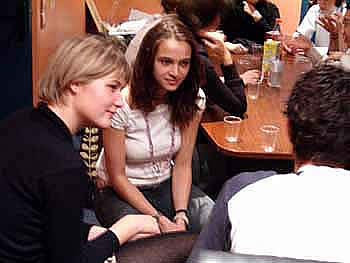
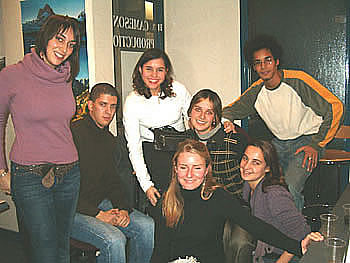
Every Tuesday, the �Club International� organizes a French-English linguistic exchange workshop. Over a two-hour period, about dozen people � students, young professionals, Francophones, Anglophones and others � converse about various subjects. It�s the perfect occasion to hone one�s language skills in a friendly atmosphere |
|||
|
The number of participants varies. On average, a group of more or less fifteen gather at the �Club International� to participate in the workshop. Conversation begins in French. Some are regulars. �I come every Tuesday�, shares Duyhai, 24 years old, employee. �I appreciate being able to talk to real Anglophones�, he adds. �It allows me to keep my skills sharp.� Others are first-timers, which provides a certain amount of turnover. The evening�s goal is the same for everyone: sharpen their French or improve their English based on the simple principle of exchange. �I need to practice my English orally, especially for my job�, admits Arnaud, 25 years old, programmer.
|
||
The workshop settles in on its own and naturally
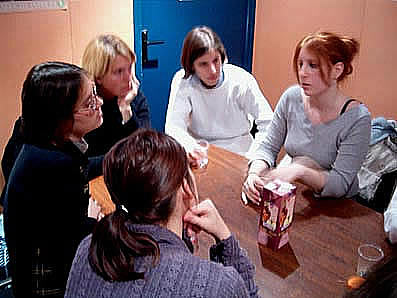
It�s 8 PM. Everyone picks a seat at the round table, like a family gathering for supper to talk about their respective day. Chance guarantees a double mix � men/women, Francophones/Anglophones. With a drink in hand (non-alcohol juice, of course!), jaws loosen up. The first hour generally unfolds in French. Small informal groups form for the first phase of mutual exploration
No requirements or mandatory exercises It becomes obvious that a sample of the world has gathered around the table: Australia, Syria, England, the United States, Germany, etc. There are no requirements or mandatory exercises � only a shared desire for exchange. Beginning with personal introductions, conversation evolves through varied and interrelated subjects. Based on personal experience, a small group explores the theme of educational systems. Other subjects get thrown in, and a discussion on the death penalty ensues. No subject is forbidden. A debate on mass transit emerges, subsequently returning to more down-to-earth matters. Meanwhile, several anecdotes and bits of life experience make their way into the conversations. Understanding is working well. Experiences meld with opinions. Mazhar, originally from Turkey, exposes his view of the English and French educational systems. He knows what he�s talking about, having lived there. Helen, a student from Leeds in Paris for a few weeks, backs his position. |
9 PM � conversation continues, but in English Some listen, some talk, some search for the right word, and the clock�s virtual gong sounds. It�s around 9 PM. Without interruption, conversation continues in the language of Shakespeare. Attitudes and dynamics reverse. Some, not quite comfortable in French, come back charging and others, the Francophones, become suddenly less noticeable. Diverse and varied subjects Life in Paris, the latest film seen at the movie theatre, cancer, road safety� One thing is certain, in either language, subjects and cultural exchange are limitless. �At first, I came to accompany my friend Ele�, tells Louisa, 21 years old, English. �I thought it would be somewhat superficial to sit on a chair and say �Go on, speak!��, she continued. �But it works quite well. We form a small committee, and even the shy ones end up talking.� It�s a bit past 10 PM and time definitely flew. |
|